

Site Search
Search within product
第717号 2020(R02).01発行
Click here for PDF version
Toward the §2022 era
Jcam Agri Co.
管理本部長 安藤 嘉章
§鹿児島県島しょ地域におけるサトウキビ栽培土壌の理化学性の実態
Kagoshima Agricultural Development Center
餅田 利之
§アールスメロンの紐栽培 肥効調節型肥料の全量基肥と吸肥・吸水パターン
Former Faculty of Agriculture, Okayama University
桝田 正治
山岡 史和
Toward the 2022 Era
Jcam Agri Co.
管理本部長 安藤 嘉章

Happy New Year!
At the beginning of the year 2020, I would like to extend my greetings to all the readers of "Agriculture and Science".
平成21年10月にチッソ旭肥料㈱と三菱化学アグリ㈱が合併した弊社は,おかげさまで10周年を迎え11年目に入りました。これもひとえに皆様方のご指導・ご支援の賜と存じます。改めまして厚く御礼申し上げます。
Last year was a year in which we witnessed up close the fury of repeated natural disasters. Of particular interest to me was the number of cases in which people were affected by disasters while evacuating or taking action by car. I was reminded once again that we must abandon the stereotype that because we are driving a car, we are safe. The danger of evacuation by car is that the water level rises around you while you think you are still safe, and you are unable to escape from the car. Although cars have been considered effective for evacuation, I was reminded of the high risk involved. I would like to express my deepest sympathy to all those who have suffered from the disaster, and my sincere wishes for the recovery of the affected areas.
This year is the year of the Tokyo Olympics, and as someone who was born in the previous Tokyo Olympics, I am deeply moved by this year's events. Although it is expected to be the beginning of a dynamic era, the biggest challenges facing Japan in the 2022 era are population decline and aging, and it is said that Japan will soon become an economic superpower with the fastest population decline in the world. According to the Population Projections released by the National Institute of Population and Social Security Research in April 2009, the total population was 125 million in 2020, will fall below 100 million in 2043, and is expected to drop to 92 million in 2042. This means that about a quarter of the population will decline over the next 40 years. Even more serious is the accelerating decline in the birthrate, with the working-age population (15-64 years old) expected to decrease by about one-third over the next 40 years.
The environment surrounding agriculture is expected to become more severe year by year, and the introduction of advanced technologies such as ICT, robotics, and artificial intelligence (AI) will accelerate in order to reduce agricultural materials and improve agricultural production efficiency. We will further enhance our recognition of one of our corporate philosophies, "Contribute to agriculture and related fields in Japan and around the world through fertilizer business," and based on the fertilizer technologies we have cultivated, we will continue to develop fertilizers to meet the demands of the 2022 era, with the key points of labor saving for farmers, effective utilization of fertilizer resources, reduction of production costs, and reduction of environmental impact. We will continue to develop fertilizers to meet the demands of the 2022 era.
Finally, I would like to conclude my New Year's greetings by expressing my gratitude for your continued patronage of this issue of Agriculture and Science, and my best wishes for your happiness and prosperity in the coming year.
In the Kagoshima Island Region
サトウキビ栽培土壌の理化学性の実態
Kagoshima Agricultural Development Center
餅田 利之
Introduction
Sugarcane cultivation in Japan is flourishing in the island areas of Okinawa and Kagoshima prefectures, and sugarcane for sugar production (excluding brown sugar and brown sugar) in Kagoshima Prefecture is grown on six islands from Tanegashima in the north to Yoronjima in the Amami Islands in the south (Figure 1). However, in Tanegashima and Amami Islands, it accounted for 151 TP3T and 301 TP3T, respectively, the second highest share after beef cattle. Sugarcane also accounts for a high percentage of the total cultivated area of major crops in Tanegashima and Amami Islands with 311 TP3T and 571 TP3T, respectively. Sugarcane is the main staple crop in the island areas of the prefecture.
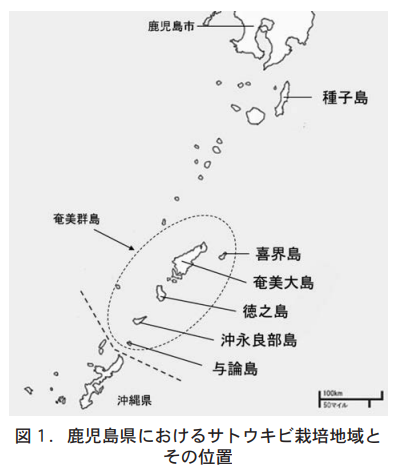
In recent years, however, sugarcane unit yield and production have been declining in this prefecture, and recovery of unit yield and production stability have become urgent issues. In addition to weather disasters such as typhoons, outbreaks of pests and diseases, and inadequate cultivation management due to labor shortages, deterioration of soil physicochemical properties is considered to be one of the factors contributing to the decline in unit yield.
This paper introduces the types and characteristics of sugarcane cultivated soils in this prefecture, and describes the actual conditions of soil physicochemical properties, as well as problems in sugarcane production and their solutions.
2. soil type
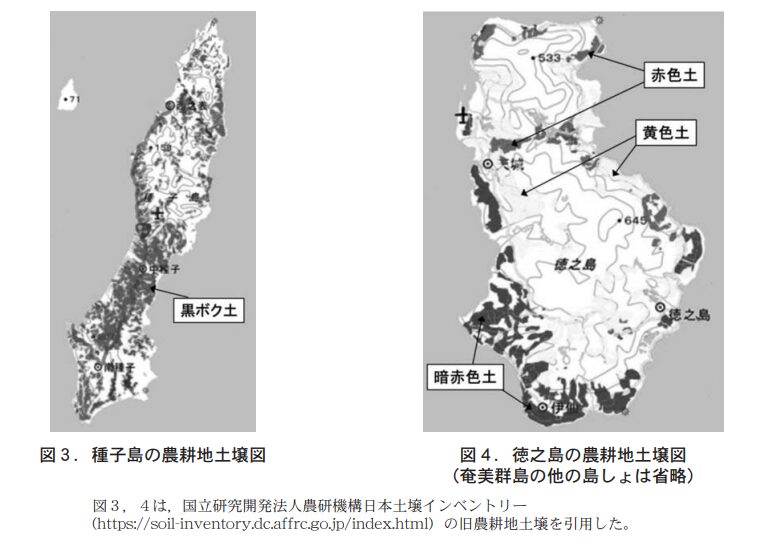
Figure 2 shows the types of soils distributed in the sugarcane growing areas and their area percentages by parent material. The parent material of the field soils on Tanegashima is mainly volcanic ash, with black earth soils accounting for more than 90% of the total area. The remaining less than 10% are yellow soil and dune immature soil distributed mainly along the coast in the western part of the island (Figure 3).
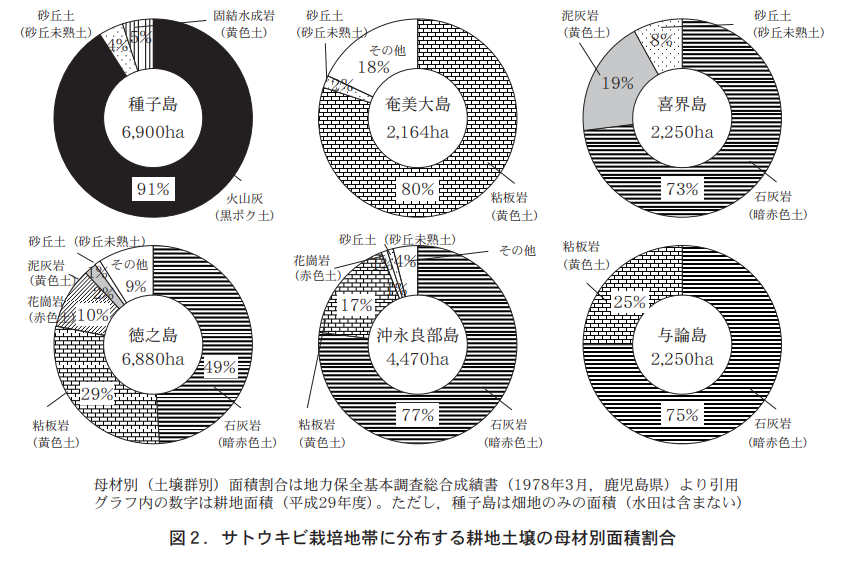
On the other hand, the Amami Islands are composed mainly of limestone (coral), slate (sedimentary rock), granite (igneous rock), marl (sedimentary rock), and sea sand, which are very different from those of Tanegashima Island. Limestone weathered soil (hereinafter referred to as "dark red soil") accounts for approximately 541 TP3T of the total arable land area in the Amami Islands, and is widely distributed in the coastal areas of the islands. Weathered soils of slate and granite (yellow soil and red soil, hereinafter referred to as "red-yellow soil") are distributed in the mountainous and hilly areas of Amami Oshima and Tokunoshima (Fig. 4). In the eastern part of Kikai Island, about 300 ha of marl weathered soil (called jargal in Okinawa Prefecture) is distributed, and this soil is considered the most productive soil in the archipelago because it is richer in nutrients and retains water better than other soils.
3. soil properties
Here, we mainly discuss the black-bok soils of Tanegashima Island, and the dark red and red-yellow soils of the Amami Islands.
(1) Black Bok Soil (Tanegashima Island)
The physico-chemical characteristics of the Tanegashima black soil are similar to those of the mainland Tanegashima black soil. The Tanegashima Kuroboku soil tends to be slightly thinner and has less humus content than that of the mainland, but it is more humus-rich and swollen than the sugarcane soils of the Amami Islands, and is very easy to work. In addition, because of its high water retention capacity, the sugarcane is less susceptible to drought damage in the summer. The soil pH is low and acidic, and phosphoric acid is easily deficient due to its high fixation capacity.
(2) Dark red soil (Amami Islands)
It is distributed on all islands in the archipelago except Amami Oshima. The soil is weathered from uplifted coral reefs and is very sticky and difficult to till. In Okinawa Prefecture, this soil (commonly known as "Shimajiri Merge") is regarded as an easy-to-work soil because of its well-developed soil structure and soft, swollen soil. However, in our prefecture, it is regarded as a soil with poor workability together with reddish yellow soil, which will be described later, because of the comparison with black-bok soil.
It is also susceptible to drought damage due to its high permeability and low water retention in the field. Soil pH is high, generally neutral to slightly alkaline, and lime content is high, but humus and phosphate content is low. The humus content is particularly low not only in dark red soils but also in all field soils distributed in the Amami Islands. For example, even if 4 t/10a of compost is applied, which is the upper limit of the amount of compost applied in the soil improvement project, the humus content in the soil is often less than 51 TP3T, the target value of the project.
(3) Reddish yellow soil (Amami Islands)
These soils are weathered slate and granite, and are generally highly cohesive and harden upon drying, making them difficult to work. However, some granite-weathered soils are less cohesive, and sandy soils that are less susceptible to solidification are also distributed. The soil physical properties, humus content and phosphate content are similar to those of the dark red soils described above, but the soil pH is low in many fields. Sugarcane, a grass crop, absorbs a large amount of silicate, but in general, many of the fields have low levels of edible silicate.
4. actual condition of soil physicochemical properties
(1) Soil physical properties
In recent years, with the introduction of large agricultural machinery and the increase in the area of sugarcane harvested by harvesters (harvester harvest rate for the entire province 1998: 32.91 TP3T, 2008: 71.71 TP3T, 2017: 92.61 TP3T), there is concern about the deterioration of soil physical properties due to tread pressure (Photo 1).
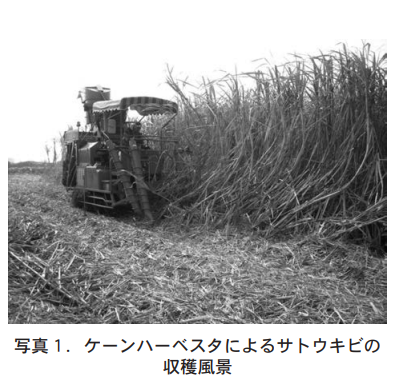
Table 1 shows the results of soil physical properties surveys conducted from 2011 to 2013 in sugarcane fields on Tanegashima and Tokunoshima. The average soil hardness of the next layer just below the crop layer was within the Kagoshima Prefecture soil diagnostic standard (22 mm or less) for both soils. On the other hand, the vapor fraction of soil pF1.5 was 101 TP3T or less in all soils, which was lower than the standard value (calcareous soil 151 TP3T or more, and other soils 201 TP3T or more), especially in the dark red soil.
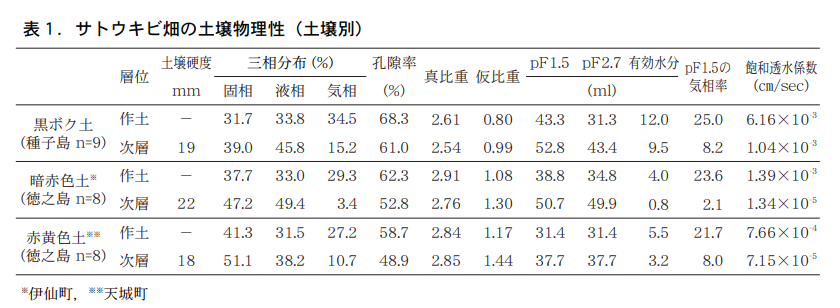
In a survey conducted on Tokunoshima Island at about the same time from 2010, soil hardness in the next layer of dark red soil exceeded the standard value in about 40% of all survey points (data omitted). In addition, the relationship between the number of years after soil preparation and soil hardness in the next layer was investigated.
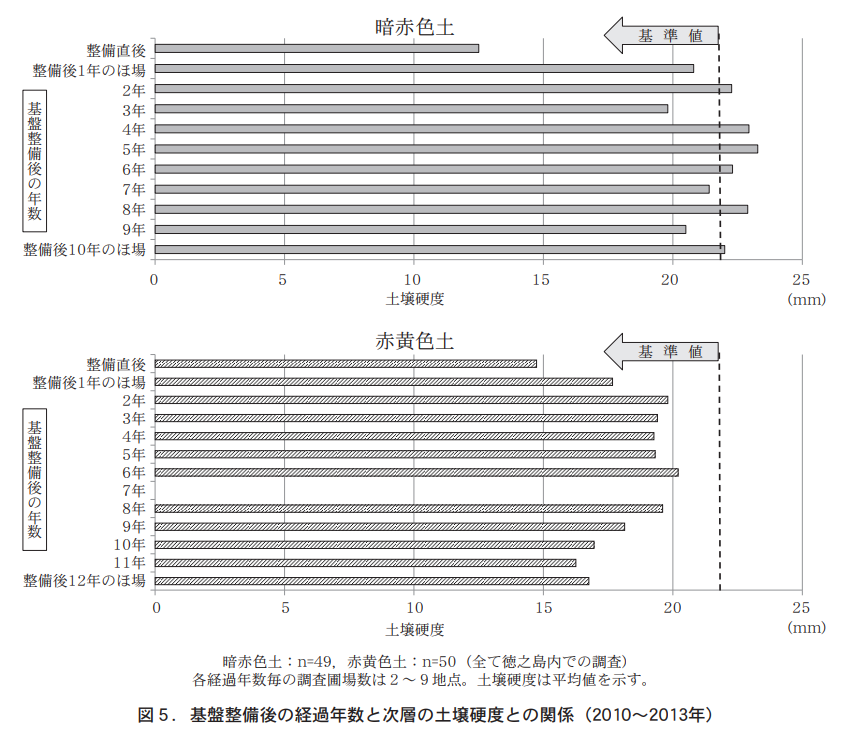
These results indicate that the subsoil in sugarcane fields tends to compact and harden regardless of soil type, especially in dark red soils with high clay content. This may have inhibited the growth of sugarcane roots and hindered the growth of sugarcane. Based on the change in soil hardness after foundation preparation, it is inferred that the deterioration in soil physical properties is due to the effects of management work during the growing season and the running of large agricultural machinery during harvesting. In order to stabilize sugarcane production, it is necessary to continue improving the subsoil layer, especially in dark red soil, by deep plowing, etc., even after the soil base is improved.
On the other hand, as described in "3. Soil Properties," the dark red and red-yellow soils of the Amami Islands were less than half of the black-box soil of Tanegashima. Especially in the dark red soil, the effective moisture content (average value) of the next layer was less than 1 ml.
(2) Soil chemistry
Table 2 shows the results of soil chemistry surveys of sugarcane fields conducted over a six-year period, 2012-2017 for Tanegashima and 2012-2017 for Tokunoshima, respectively. In the black-bok soil of Tanegashima Island, soil pH was below the standard in about 70% of the fields, and exchangeable calcium content was below the standard in 90% of the fields. In the Amami Islands reddish-yellow soil, soil pH was below the standard value in about 80% of the fields, and exchangeable calcium content was below the standard value in about 80% of the fields.
These results indicate that many of the plots in the black-bok soil of Tanegashima Island and the red-yellow soil of the Amami Islands are calcium-deficient and require acidity correction.
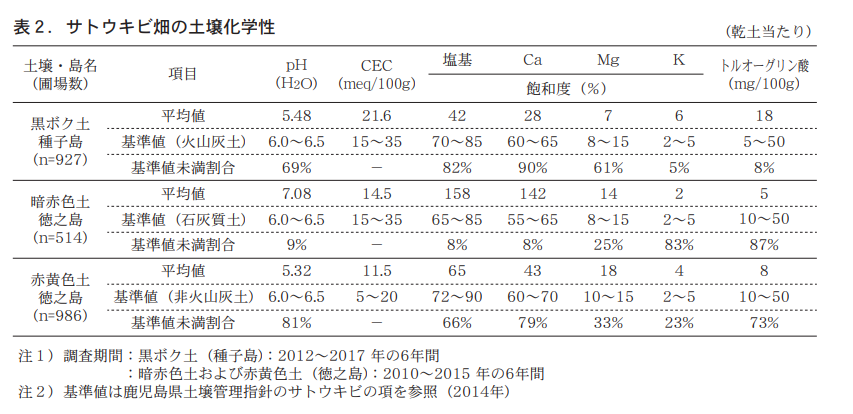
Regarding the content of edible phosphoric acid (toluoglinic acid) in the soil, less than 10% of the plots in the Tanegashima black granular soil were below the standard value, while approximately 70% of the plots in the Tokunoshima reddish-yellow soil and 90% of the plots in the Tokunoshima dark red soil were below the standard value. As described in "3. Soil characteristics," black granular soil has a high phosphate-fixing capacity, and there had been concern about phosphate deficiency in the past, but this survey revealed that there were few phosphate-deficient fields in sugarcane fields on Tanegashima.
In the dark red soil of Tokunoshima, more than 80% of the plots had exchangeable potassium content below the standard value.
5. problems and responses based on soil survey results
Based on the results of soil physico-chemical investigation, (1) subsoil hardening (especially dark red soil), (2) low effective moisture content (dark red soil and reddish yellow soil), and (3) soil acidification (black soil and reddish yellow soil) are the main problems for sugarcane growth. As for problem (2), construction of national dams and field irrigation are now underway in various parts of the Amami Islands, which is expected to reduce drought damage caused by water irrigation. In this section, we introduce the technologies and approaches currently under investigation and research with regard to the problems (1) and (3).
(1) Improvement of soil physical properties: Management using a towed plow (called "scoop")
The technology introduced here is a towing-type plow and its work system developed at the Tokunoshima Branch of the Center for the purpose of facilitating management operations after sugarcane harvesting. It also contributes to the improvement of soil physical properties by creating cracks in the subsoil and improving drainage (Photo 2).
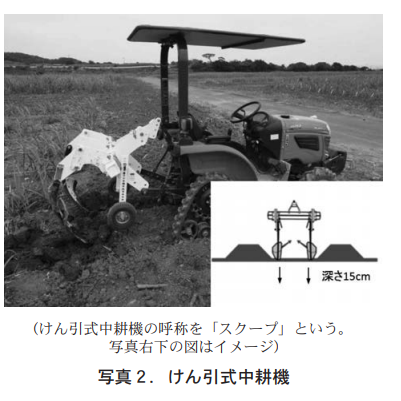
In conventional rotary plowing, dead sugarcane leaves (hakama) clog the plow, making it inefficient in terms of management work. In addition, although conventional subsoiler tillage is highly effective in breaking up the tillage bed, it causes the same problem in terms of workability as described above. This technique using a subsoiler is fast (about 1/4 of the time required by rotary plowing) because it inverts the soil while burying the leaf blades, and it is possible to make two clefts at a depth of 15 cm between the beds in a single run.
(2) Optimization of soil pH: Creation of a quick reference table of neutralizing lime amounts
In order to efficiently and effectively correct acidity in sugarcane and other cultivated fields, a table of neutralizing lime amounts was prepared (Table 3). The amount of calcium carbonate (kg/10a/10cm, hereafter referred to as "calcium carbonate") required to achieve a pH of 6.0 was calculated based on data obtained to date on the amount of neutralizing lime, which was determined from the measured soil pH and cation exchange capacity (CEC) for each soil type. This is because the amount of calcium carbonate required to correct acidity varies depending on the clay content and humus content of the soil, even in the same soil type.
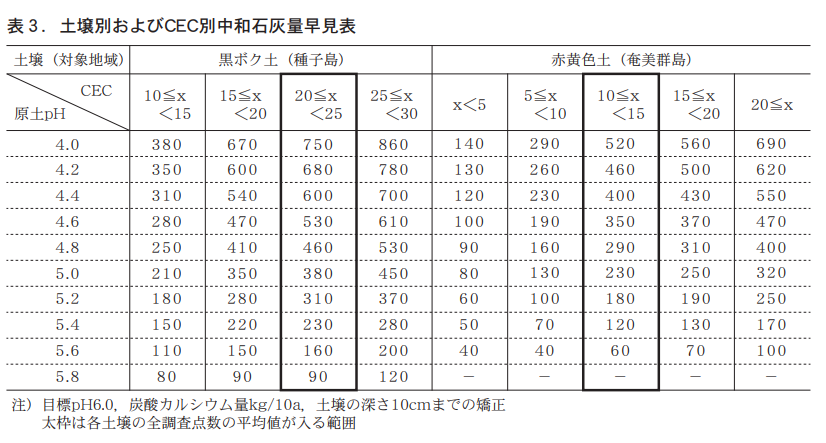
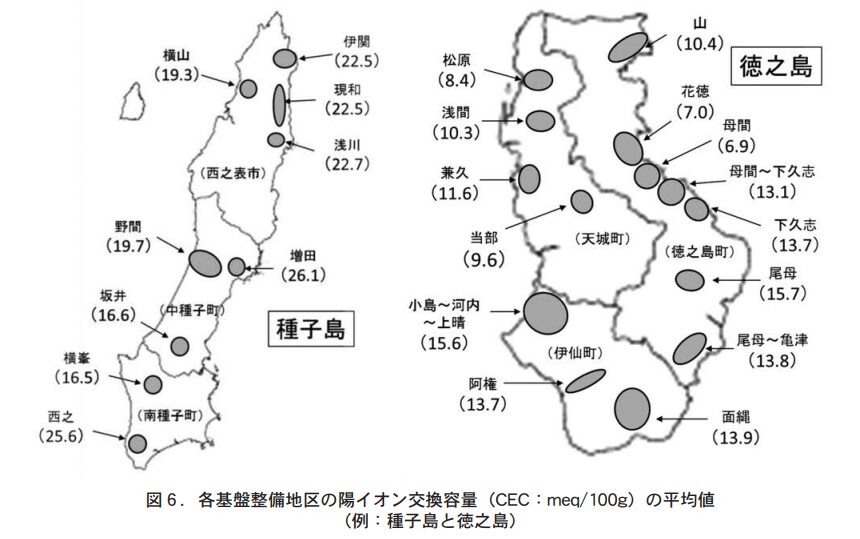
なお,CEC値については,該当する圃場が基盤整備地区内であれば,そのデータ(地区内圃場の平均値)を参考にするとわかりやすい(図6) 。基盤整備地区外でも近隣の基盤整備地区のデータを,またそれでも判断しにくい場合は,同じ種類の土壌の平均的なCECを参考にすると良い(表3太枠部分) 。
6. Conclusion
To support recovery of sugarcane yield and stable production in terms of soil management, it is important not only to improve physical properties and correct acidity, but also to address phosphoric acid and potassium deficiency in the soil, compost application, and introduction of green manure, which were not discussed in detail in this report. We hope that the actual condition of soil physicochemical properties will continue to be monitored, and that effective soil preparation will be practiced in accordance with local soil characteristics and conditions.
Cord cultivation of Earl's melon
Total basal fertilizer and water uptake and absorption patterns of fertilizer with regulated fertilizer
Former Faculty of Agriculture, Okayama University
桝田 正治
山岡 史和
Introduction.
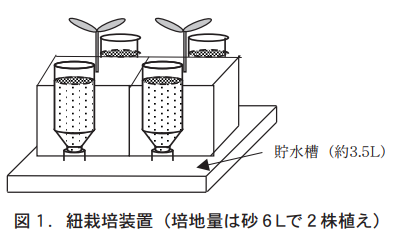
前報1)では,トマトの紐栽培における被覆肥料ブレンドの留意点について述べた。定植直後の肥料の溶出に関する留意点はメロンでも同様である。アールスメロン1株が必要とする窒素肥料は9〜13gとなることを多くの論文は示しているが,著者らのこれまでの試験では交配以降に肥料を効かすと裂果が発生しやすくなること,メロンではトマトのようにアンモニア態窒素による生理障害,とりわけ尻腐れ症は問題とならないためLPコートが使えることを数回の栽培試験において確認してきた。本手法では,水は作物の要求に応じて自動供給され,水は一切容器外に流出することがないため,吸水量を的確に測定することが可能となっている(図1) 。
小西2)はメロンにおける吸水量を計器蒸発皿からの蒸発量で除し,その値を蒸散力と名づけた。
しかし,蒸発皿は水面での気象要因にしか反応しておらず,大気の影響を総合的に反映させるには難点も多い。黒瀬3)は透明塩ビ管の先端にポーラスカップを装着した簡易な構造の水蒸発計器を考案しているが,これは管に水を満たしてシリコン栓で密封しポーラスカップからの蒸発量を計る手法である。
本研究ではこれを採用し,塩ビ管内の減水量を測定すると同時に容器に逆さに立てたペットボトルの減水量を計り,後者を前者で除し,それを植物の生長に伴う「吸水能」と名付けた。この値は水量を水量で除しているので単位を有さず,概念としては諸々の気象要因を捨象した値,まさに生育段階における植物自体の内発的水要求値として理解できよう。
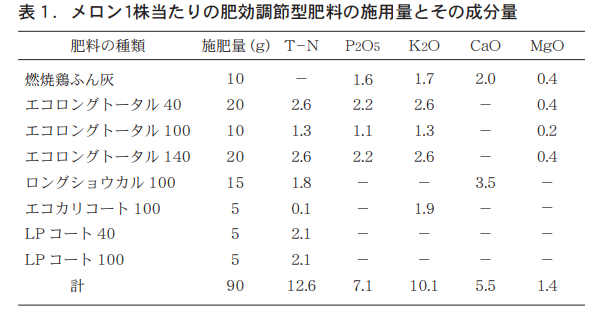
The water requirements of crops vary depending on the type of crop, the variety, and the growing environment, so it is important to predict the amount of water required before planting in order to consider economic production in agriculture, especially water availability and its means. In this paper, we compare the effects of the total fertilizer mixing method and the culture medium management method on the growth and fruit size of melons grown in sandy soil. In this study, the amount of fertilizer applied per melon plant was set slightly higher at 12.6 g of nitrogen, because the study was a comparison with culture medium management (Table 1).
Outline of cultivation
Summer-type Earls melon 'Masa' (Ueki cross) was used. The seedling medium was river sand (sieved through a 2 mm sieve), and the seedlings were potted in vinyl chloride pots with an inner diameter of 9 cm and a volume of 250 ml on April 15. At the same time, Ecolong Total 313-40 was mixed into the sand at a rate of 3 g/pot. The seedlings were watered from the bottom for about 2 weeks, and then planted in the fertilizer and culture solution areas. The fertilizer design is shown in Table 1, all of which were mixed before planting. The culture medium was managed by the so-called Otsuka A method with an EC of 1.6 dS/m until one month after mating, after which the control concentration was reduced to 1.2 dS/m because the EC value of the soil solution increased.
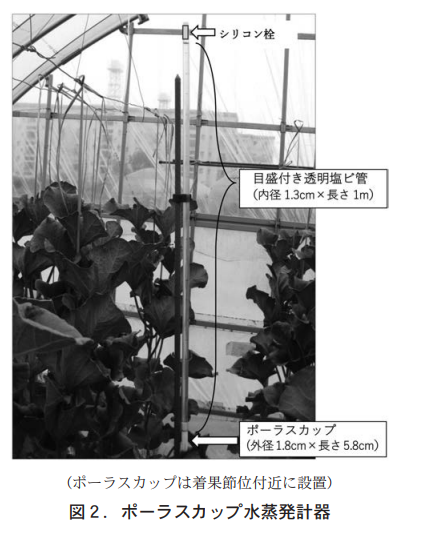
The amount of sand media was 3 L per plant, mixed with fertilizer the day before planting, and naturally watered with water from a PET bottle using a "root prevention watering string. The basic design was such that four PET bottles could stand per box, and 7 boxes (14 plants) in each area were tested. The amount of water loss was totaled every week except during the peak season, and the amount of water absorption was calculated by subtracting the amount of evaporation from the soil (the amount of water loss in the blank). The temperature in the greenhouses was heated to a minimum of 18°C and ventilated at 28°C. The soil temperature exceeded 35°C on many days during the latter half of the growing season, and sometimes reached 40°C. Porous cups for measuring transpiration were placed between the leaves around the fruit at 12 nodes (Fig. 2).
Results and Discussion
Fruit Survey
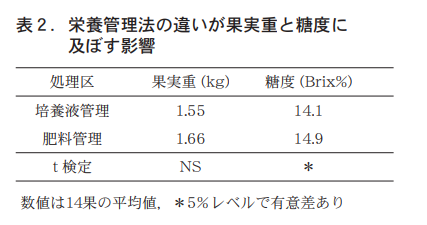
収穫果実の結果を表2に示す。果実重は培養液肥料区では1.4〜1.9kgの範囲に収まった。1970年代はアールス品種の標準重量が1.3kg前後とされていたが4),近年では1.5〜1.7kgが求められている。果実の平均糖度は培養液区で約14度,肥料区で15度となり両区間には有意差が見られた。一般に灌水を控えるとメロンの糖度は増加するが果実重は減少するとされる5)。本法の水制限を加えない紐栽培法でも果実ネットは均質で果実重,糖度はともに良品に近いものとなったが,ネットの盛り上がりは低かった。
Water absorption and water absorption capacity
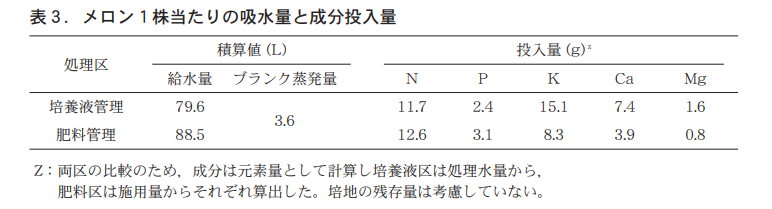
The amount of water supplied from planting to harvest was about 80 L in the culture medium area and about 89 L in the fertilizer area, and water evaporation from the soil surface during this period was about 3.6 L (Table 3).
養液土耕栽培における灌水量はメロン1株当たりおおよそ100Lとされており6),これに比べ紐栽培の給水量は明らかに少ない。1週毎に測定した累積給水量を見ると,生育が進むにつれてほぼ直線的に水量は増す(図3−A) 。収穫1週前の7月23日に両区ともに最大となり,週当たり培養液区で12.3L,肥料区で13.1Lとなった(約1.7〜1.9リットル/日) 。ポーラスカップからの蒸発量は生育初期と後期で高い値を示したが,中間期で低いのは梅雨期に相当したためと考えられる(図3−B) 。給水量から土壌蒸発量を差し引き,その値をポーラスカップからの蒸発量で除すことで得られる値を前述のように植物の「吸水能」と定義する。
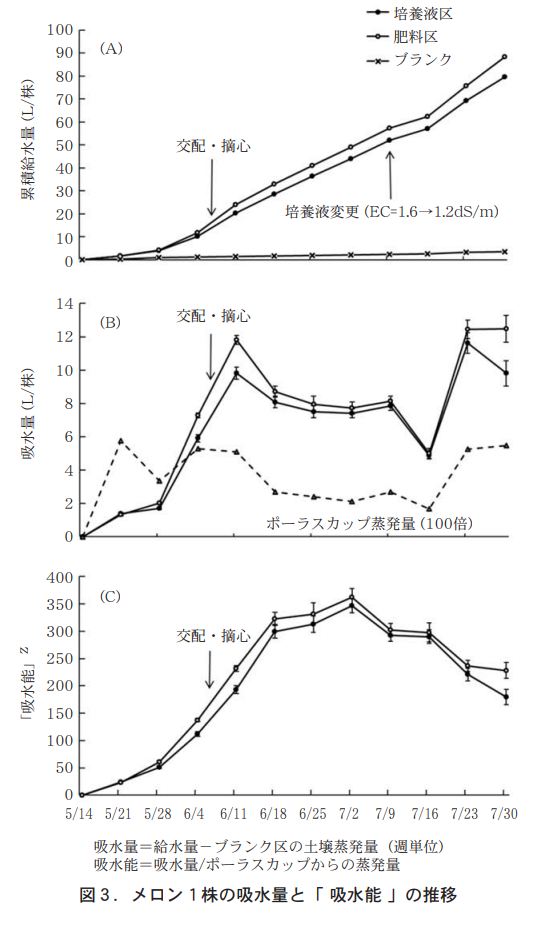
つまり,図3−Bの吸水量をポーラスカップからの蒸発量で除した値が図3−Cに示した「吸水能」である。「吸水能」は植物の生長に伴い増大し交配約3週後に最大となり,その後減少に転じた。7月2日から毎日給水量・蒸発量を測定し「吸水能」を求めたところ,わずかに右下がり傾向を示し図3−Cの同期の右下りに符合しており,晴天,曇天,雨天などの気象変動の影響を受けていないことが検証された(図4) 。
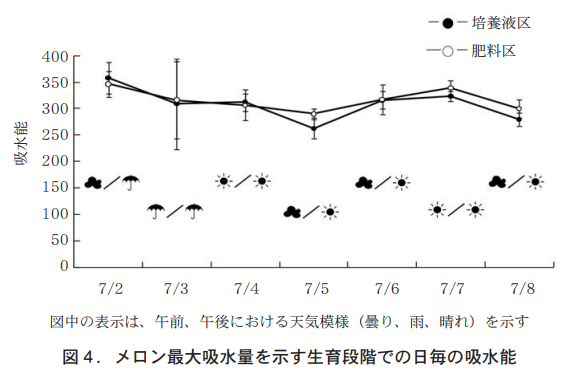
This result suggests that the concept of "water absorption capacity" is effective in identifying the growth stage in which the plant's own water demand is at its maximum, independent of weather factors. When water absorption capacity declines, root nutrient absorption also shifts from positive to negative, and it is important to manage fertilizer in a so-called "rightward" direction, even when applying mono-fertilizer or chemical fertilizer.
Soil solution analysis
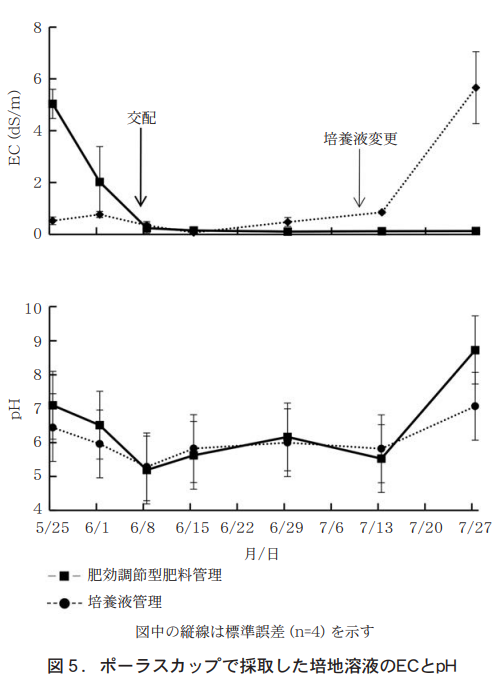
両区4株について,あらかじめ埋め込んだポーラスカップから溶液を夕方に採取した。 ECおよびpHの推移を図5に示す。採取液の濃度は培養液管理区で交配40日後頃から急激に増加し収穫時の7月27日にはEC6.0と高い値になった。反対に肥料管理区では生育初期に5.0と高い値を示したが交配時には0.2となり,その後収穫時まで低いまま推移した。これは肥料粒子から溶出した養分がほとんど根に吸収されており,土壌溶液中には皆無となっていることを示唆する。この土壌溶液の変動パターンはトマトでも同様である1)。pHは両区ともほぼ5〜7の間で推移した。肥料区では栽培終期にpH8を超える値となったが,生育には大きな影響を与えなかった。なお,この値は連作を続けていると徐々に低下していく。
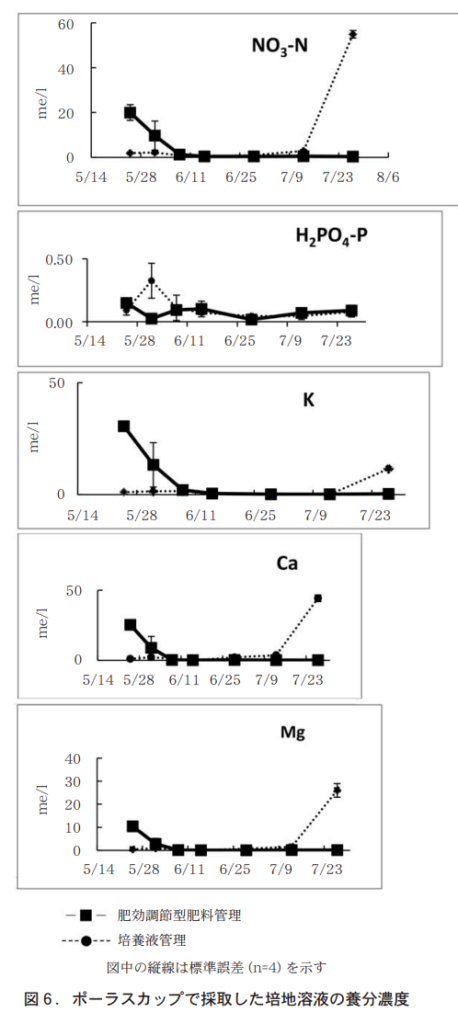
現在(第8作目)では,燃焼鶏ふん灰10gあるいは苦土石灰約40gを作付け前に全層6Lに混和しており生育は 安定している。各成分濃度の推移についてはH2PO4−Pを除いてECの変動パターンと同様の傾向にあった(図6) 。H2PO4−Pは,両区とも栽培終期には不溶性リン酸の形態に変化しているものと推察された。表3には投入量から算出した元素としての総量を示したが,NとPは培養液管理区,肥料管理区でほとんど差がない。
しかし,K・Ca・Mgは培養液管理区で肥料管理区の約2倍投入したことになる。張・糠谷7)は温室メロンのロックウール栽培では,生育前半のステージにおける培養液濃度は高めにし,後半は低下させる管理が養分吸収特性に対応すると報告しており,本試験においても生育後半にEC値が高くなり始めたので培養液管理濃度を1.6から1.2dS/mに落としたが,それでも培地溶液のECは急上昇した。
これに対して,肥料管理区のEC値は絶えずゼロ付近で推移しており,いずれの成分も溶液中には存在せず根から吸収され尽くしているものと考えられた。なお,肥料管理区で着果節位の葉縁に黄褐色変が観察され,K欠乏が疑われたが果実品質には問題はなかった。
以上の結果より,肥効調節型肥料による肥培管理はメロンの吸収特性に符合していると考えられ土壌溶液中に養分が残らず極めて合理的と言える。なお,メロンにおいてもトマトで報告1)したように,茶袋に入れて施用し栽培終了時に残った肥料を取り除くことができれば培地の半永久的再利用は容易になる。この点に関しては今日まで数年間,茶袋投入でメロンの連作を行っており,この連作要因について太陽熱消毒も含めて次報で解説する。
Reference materials
1.トマトの紐栽培−肥効調節型肥料の紐上置き肥.
桝田正治.農業と科学708:1−6.2019.
2.マスクメロンの水消費と消費特性.
小西国義.岡山大農学報43:27−37.1974.
3.ポーラスカップを利用した蒸発計の開発.
黒瀬義孝.日本農業気象学会中四国支部報21:1−7.2008.
4.新版温室メロンの栽培と経営.
神谷円一.誠文堂新光社.1973.
5.メロン果実への光合成産物の転流・分配に及ぼす葉位および灌水量の影響.
宍戸良洋・湯橋勤・施山紀男・今田成雄.園芸学会誌60(4):897−903.1992.
6.メロンの養液土耕栽培における給液量と生育の関係.
鈴木雅人・金子賢一.茨城園研報11:9−14.2003.
7.温室メロンのロックウール栽培における培養液濃度と養分吸収の関係.
張洪基・糠谷明.園芸学会誌66(2):307−312.1997.